
Off-the-Shelf Platform or Custom Online Store Development: Which Is Better for Your Business?
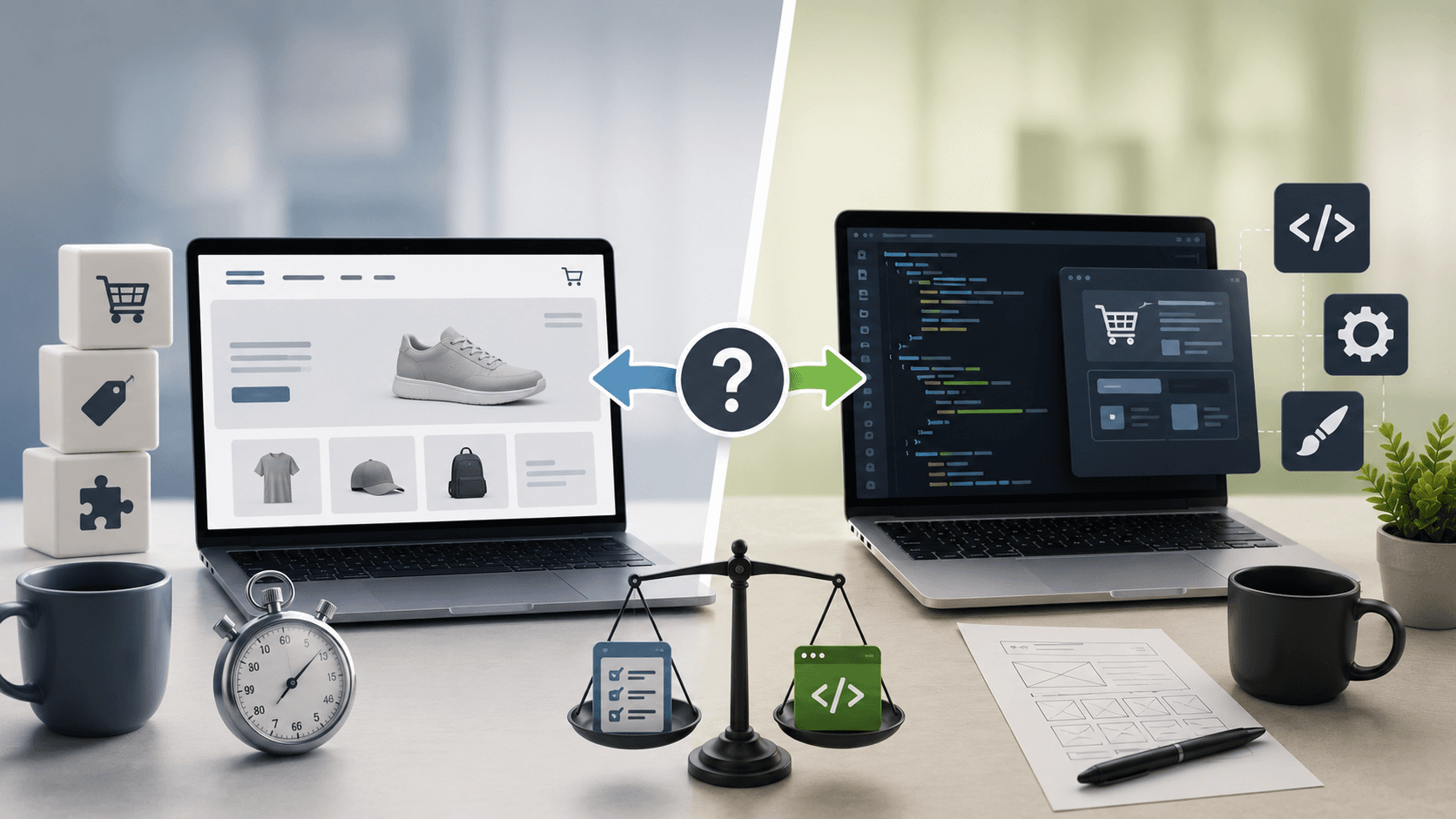
When you're figuring out how to launch an online store, the first and most important decision you make isn't the design or the product catalog — it's whether to build your online store on a ready-made platform (WooCommerce, Shopify, and similar) or on a solution built specifically for your business. This choice determines not only what your store costs today, but what it will cost you two or three years from now, once the business grows.
In this article, we break down the difference between these two approaches, their pros and cons, and give a clear recommendation depending on where your business currently stands.
What Is an Off-the-Shelf eCommerce Platform?
An off-the-shelf platform is a pre-built solution that gets installed and configured, with no need to write code from scratch. The best-known examples are WooCommerce, Shopify, and OpenCart.
Advantages of an off-the-shelf platform:
- Fast launch — a store can go live within a few days
- Lower upfront cost — smaller initial investment compared to custom development
- A large library of ready-made plugins and themes — for basic functionality, an existing solution is usually available
Disadvantages of an off-the-shelf platform:
- Limited customization — specific business needs (a particular pricing logic, integration with a local ERP system, a non-standard checkout flow) are often difficult or expensive to add later
- Costs that grow with sales volume — monthly subscriptions and transaction fees increase as the store grows, rather than staying fixed
- Dependency on the platform provider — data, design, and functionality are tied to someone else's system, which makes migrating to another solution harder down the line
What Is Custom Online Store Development?
Custom development means the online store is built from the ground up, matching your business's exact processes and needs — without the compromises a ready-made platform forces on you.
Advantages of a custom solution:
- Full customization — every feature is built around your business, not a generic template
- Ownership of the system — customer data, order data, and the entire codebase belong to your company, with no dependency on a third-party provider
- Better scalability — the system grows alongside your catalog, order volume, and new integrations, without needing to be rebuilt from scratch
- Direct support from a team that knows your system — faster problem-solving because the team that built the solution knows every part of it
Disadvantages of a custom solution:
- Higher upfront cost — a bigger initial investment compared to an off-the-shelf platform
- Longer development time — building from scratch takes more time than installing a ready-made solution
Which Is Better for Your Business?
The right choice depends on the stage your business is at right now:
- An off-the-shelf platform makes sense if you're still testing an idea, selling a small number of products, and want to see whether online sales have real demand before committing to a bigger investment.
- Custom online store development makes sense as soon as you have a clear product range, plan to scale sales, or have already tried an off-the-shelf platform and hit its limits — whether through costs that grow with sales or features that simply can't be implemented.
The most common mistake we see is basing this decision purely on upfront cost, without thinking through what happens once the store actually starts to grow. A custom solution typically pays for itself faster than expected, since it eliminates rising monthly costs and dependency on someone else's system.
Conclusion
There's no one-size-fits-all answer to how to launch an online store — the answer depends on your goals, budget, and growth plans. What is certain is that building an online store requires a clear assessment not just of the upfront cost, but of how much the solution will cost — and limit — you down the line.
If you're thinking about building an online store and aren't sure whether an off-the-shelf platform or a custom solution is the better fit, get in touch with the Noxuz team — we'll look at your specific needs, budget, and growth plans, and recommend a solution that actually makes sense for your business, not a generic answer.
Ready for the next step?
Let's talk about your project.
Schedule a short call and let's discuss how we can help your business grow.